 The 2nd EReL@MIR Workshop on Efficient Representation Learning for
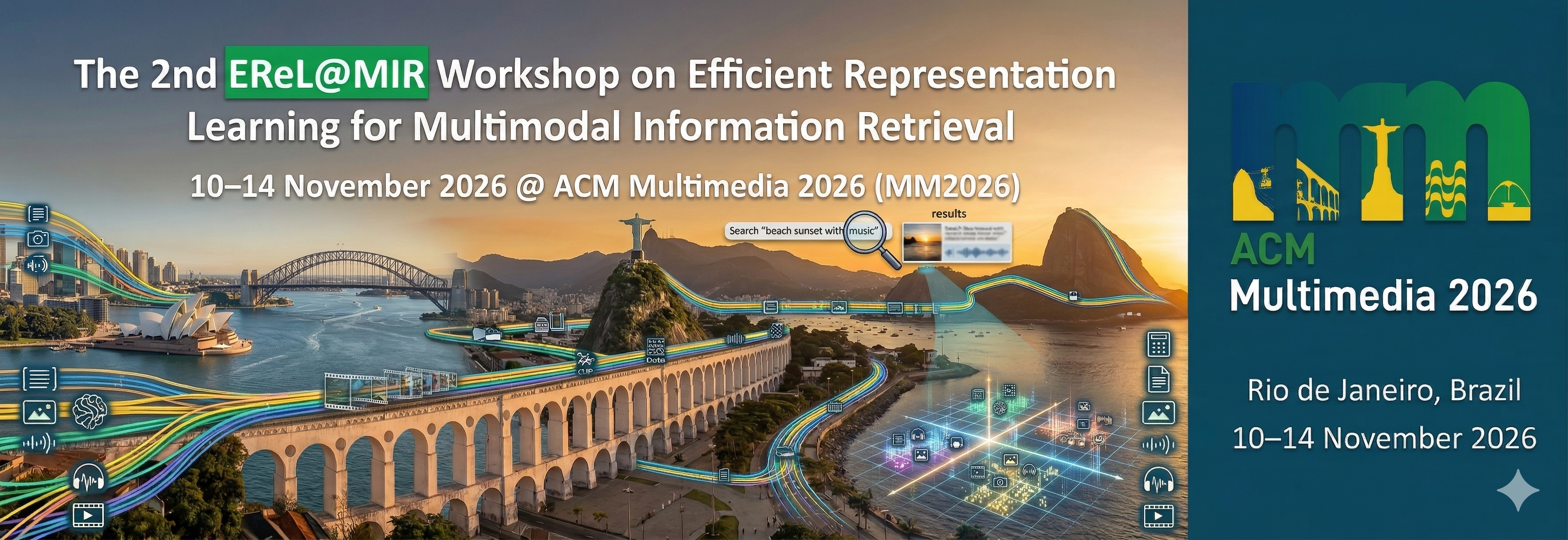
 The 2nd EReL@MIR Workshop will be co-located with ACM Multimedia 2026 in Rio de Janeiro, Brazil (10–14 November 2026).
Multimodal information retrieval (MIR) underpins modern multimedia services across both industry and academia — from large-scale recommendation and e-commerce search to general-purpose web and conversational search systems. The rapid progress of large pre-trained foundation models for language and vision–language learning (e.g., Qwen, LLaVA, and CLIP) has significantly reshaped how multimodal representations are learned and transferred across tasks. These advances have enabled strong performance in MIR settings such as web search, cross-modal retrieval, and multimodal recommender systems.
Despite these gains, deploying large multimodal models in real-world MIR pipelines exposes a persistent gap between effectiveness and system feasibility. Production MIR systems must satisfy strict latency and throughput targets while controlling VRAM, storage, and end-to-end serving costs, yet efficiency is still under-reported and inconsistently evaluated in much of the literature. This limits fair comparison, reproducibility, and practical adoption at scale — motivating research on efficient adaptation, fusion, compression, indexing, and scalable serving for MIR.
Two emerging shifts have further expanded the MIR design space and sharpened the urgency of efficiency research. First, omni-modal models unify a broader set of modalities (text, image, audio, video) within a single framework, enabling richer interactions but exacerbating computational and serving constraints: their larger scale and prompt-dependent representations make embedding pre-computation and caching difficult. Second, generative MIR approaches that generate identifiers or structured candidates introduce new efficiency and reliability challenges, including decoding-time latency, output validity and controllability, and tokenization complexity.
The 2nd EReL@MIR workshop at ACM Multimedia 2026 is a timely venue to advance efficiency-aware multimodal representation learning and multimedia retrieval. Co-located with the main MM 2026 program, the workshop strengthens core multimedia themes — including multimodal learning, vision–language modeling, multimedia retrieval, recommendation, and multimodal generation — through the lens of efficiency, deployability, and cost-aware system design. The workshop has four main goals: (i) promote research on efficiency-aware multimodal learning for large-scale multimedia applications; (ii) encourage unified metrics and benchmarks that jointly evaluate effectiveness and system cost; (iii) advance deployable solutions for real-world multimedia retrieval and generation systems; and (iv) stimulate discussion on emerging omni-modal and generative paradigms under realistic computational constraints.
Previous edition (2025) archive: https://erel-mir.github.io/2025/
ACM Multimedia 2026 (host conference) website: https://2026.acmmm.org/index.html
We invite researchers to submit their latest work on efficient multimodal representation learning for multimodal information retrieval (MIR). Topics include, but are not limited to:
Submissions of papers must be at least 4 pages and at most 8 pages (including figures, tables, proofs, appendixes, acknowledgments, and any content except references) in length, with unlimited pages for references. Submissions must be in English and in PDF format, using the ACM two-column conference format. Suitable templates are available from the ACM Website (use the “sigconf” proceedings template for LaTeX and the Interim Template for Word).
The workshop follows a double-blind review process. Submissions must be anonymized and must not include author names, affiliations, acknowledgements, or any other information that could reveal the authors’ identities.
All accepted papers will be published as workshop proceedings in the ACM Digital Library.
The review process will be conducted by our workshop program committee. Selection depends on technical soundness and relevance to the workshop community. At least one author of each accepted paper must attend the workshop on-site and present their work.
The committee will review the submissions and select one outstanding workshop paper to receive the Best Paper Award at the EReL@MIR Workshop.
MM2026 Fast Track - Papers rejected and/or withdrawn from ACM Multimedia 2026 that wish to be submitted to EReL@MIR can use the same submission link. These submissions should include the review comments in an appendix. Such papers will bypass the peer-review process, with acceptance decisions made directly by the meta-reviewers.
In the Appendix, the authors are encouraged to include a section titled “Improvements,” where they briefly outline whether they have addressed any of the issues raised in the main review and, if so, how these revisions were implemented. Only minor revisions are expected, and it is acceptable if no revisions are made where the work is already deemed to be in good shape. Major changes are not permitted, and any attempt to modify or manipulate review comments is strictly prohibited.
If you have any questions about EReL@MIR, contact: